
When it comes to protecting life, property, and operations from fire hazards, every second counts. A single spark in a server room, kitchen, or warehouse can turn into a major incident within minutes. That’s why having a properly installed fire suppression system is not just a legal requirement—it’s a life-saving investment.
However, fire suppression systems only perform effectively when they are installed following the right process. Many organizations in India still face system failures because key steps like design verification, risk assessment, or final commissioning are skipped.
To help building owners, contractors, and facility managers avoid such risks, the experts at Radiant Safety System have created a complete step-by-step checklist for successful fire suppression system installation—from the very first site survey to final commissioning and maintenance.
Step 1: Building Survey and Fire Risk Assessment
Every installation starts with a detailed site survey.
Radiant Safety’s certified engineers visit the site to analyse the layout, occupancy type, electrical load, and potential ignition points. This assessment identifies:
- Areas with high fire-risk zones (server rooms, kitchens, machinery floors)
- Type of fire expected (Class A, B, C, K etc.)
- Local regulations under NBC India and state fire department norms
A well-done fire risk assessment ensures the system design matches the building’s exact needs and helps avoid over- or under-protection.
Step 2: System Design and Agent Selection
After the survey, the next stage is custom system design.
Each building type demands a different suppression agent and delivery method.
Radiant Safety’s design team considers:
- Type of agent – CO₂, FM-200, Inert Gas, Water Mist, or Foam
- Room dimensions and ventilation
- Integration with detection and alarm systems
- Environmental factors and refill availability
For example, data centres often prefer clean agents like FM-200 or Novec 1230, while industrial plants benefit from foam-based or water-mist systems.
All designs are prepared using BIS and NFPA guidelines, ensuring both safety and compliance.
Step 3: Material and Component Procurement
Once the design is approved, Radiant Safety procures only ISO 9001:2015-certified and BIS-approved components.
Key elements include:
- Cylinders and valves
- Control panels and sensors
- Piping, fittings, and nozzles
- Detection and alarm modules
Using sub-standard material can cause leakage, delayed activation, or total system failure.
Radiant Safety maintains strict vendor checks and quality documentation to ensure long-term reliability and regulatory compliance.
Step 4: Installation and Integration
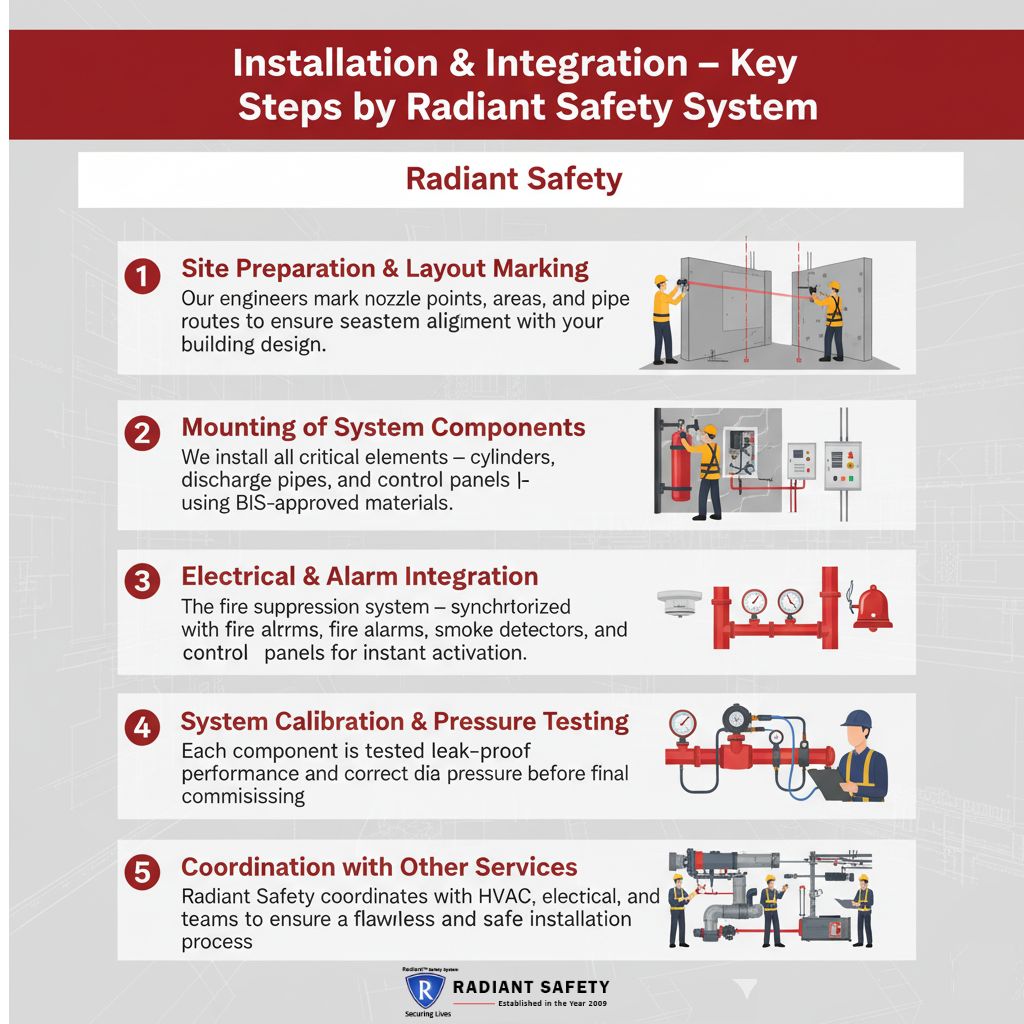
Installation is where design meets real-world performance.
This phase involves physical fitting of cylinders, nozzles, piping, detection sensors, and electrical wiring.
Radiant’s installation team works in close coordination with civil, electrical, and HVAC contractors to avoid interference with other utilities. Integration with fire alarm and smoke detection systems ensures automatic activation during an emergency.
Each joint, pipe, and electrical connection is tested for pressure and continuity before final commissioning.
Step 5: Testing, Commissioning, and Documentation
Before handover, the system undergoes comprehensive testing:
- Hydrostatic and pressure tests
- Functional discharge tests
- Electrical circuit verification
- Response-time validation
A detailed commissioning report is prepared, documenting each test result and conformity with NBC India and local fire-department requirements.
These records are crucial for obtaining and renewing the Fire NOC.
At Radiant Safety, no system is handed over until every parameter passes internal and external inspection benchmarks.
Step 6: Training and Post-Installation Maintenance
Installing a suppression system is only half the job—the other half is ensuring people know how to use and maintain it.
Radiant Safety provides on-site fire safety training to facility staff, teaching them:
- How to operate manual release stations
- What to do after system discharge
- How to read control-panel indicators
- Regular inspection routines
In addition, Radiant offers Annual Maintenance Contracts (AMC) that include periodic testing, refilling, and performance audits so that your system stays operational year-round.
Step 7: Compliance and Certification Support
Fire safety is a regulated domain in India. Compliance with BIS, NBC 2016, and NFPA standards is mandatory for most establishments.
Radiant Safety assists clients through every compliance stage:
- Liaison with fire authorities for NOC approval
- Documentation for insurance or ISO audits
- Updating layouts and drawings after modifications
This ensures that your facility is not only protected but also legally compliant, reducing future liabilities and insurance issues.
Why Businesses Trust Radiant Safety System
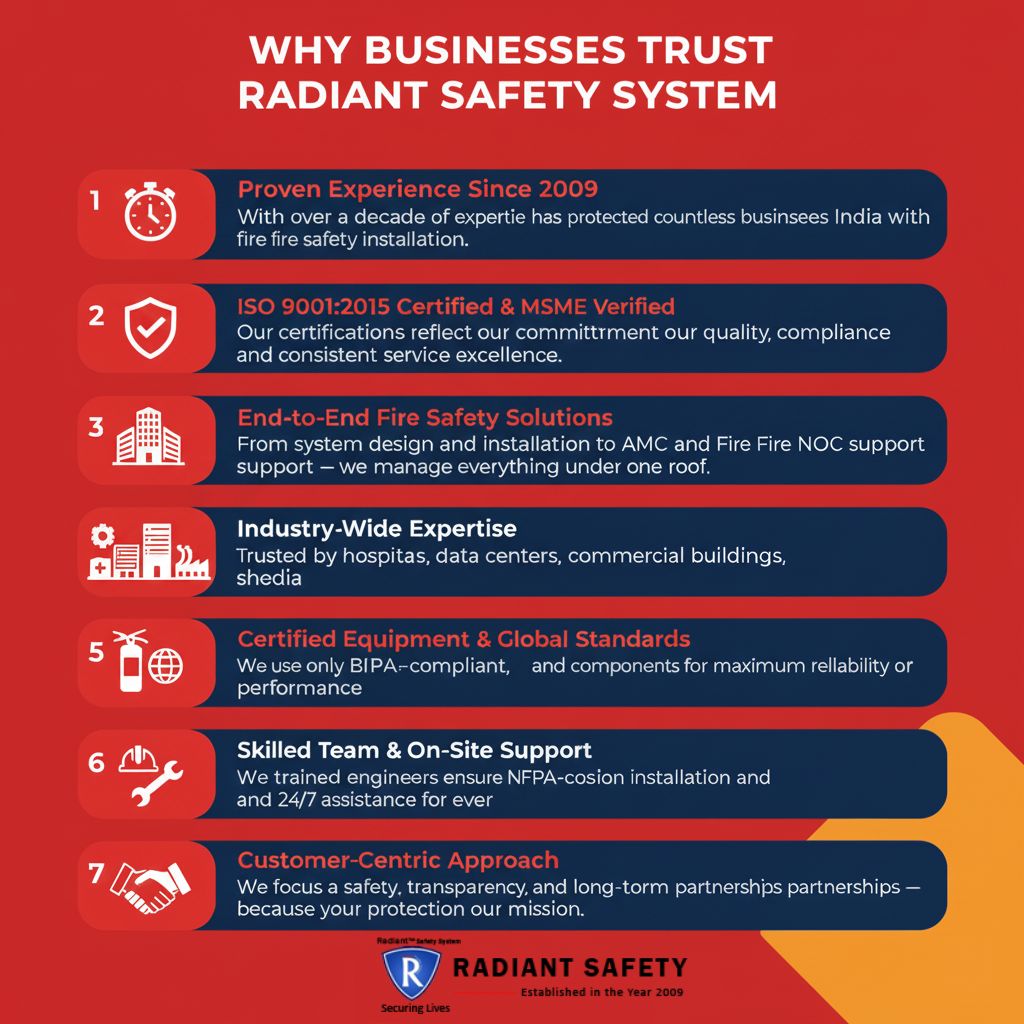
Founded in 2009 by Mr. Sunny Jain, Radiant Safety System has evolved into one of India’s most trusted fire and safety companies.
Headquartered in Delhi NCR, the company serves clients across North India and Pan-India, delivering end-to-end fire safety installations—from consultation and design to commissioning and AMC.
Key highlights:
- ISO 9001:2015-certified and MSME-verified organisation
- Expertise in Fire Suppression Systems, Fire Alarm Solutions, and Gas Leakage Detection
- Experience across sectors: hospitals, data centres, commercial kitchens, hotels, schools, warehouses, and manufacturing units
- Proven track record of delivering turnkey fire safety projects meeting the highest technical and safety benchmarks
With Radiant, you don’t just install a system—you gain a reliable partner focused on continuous protection and compliance.
Quick Installation Checklist Recap
| Stage | Key Focus | Responsible Team |
|---|---|---|
| 1. Survey & Risk Assessment | Site analysis, fire load study | Radiant engineers + client safety officer |
| 2. System Design & Agent Selection | Layout drawing, agent choice | Design team |
| 3. Procurement | BIS/ISO-approved material | Quality procurement |
| 4. Installation & Integration | Mechanical + electrical fit-out | Installation team |
| 5. Testing & Commissioning | Pressure/discharge tests, reports | QA & commissioning team |
| 6. Training & Maintenance | User training + AMC setup | Service department |
Keeping this checklist handy ensures that no critical stage is skipped, and your investment delivers maximum safety performance.
Final Thoughts
A fire suppression system is your facility’s silent guardian. But it only works efficiently when designed, installed, and maintained by certified professionals who understand Indian compliance and real-world site conditions.
Whether you manage a hospital, hotel, factory, or data centre, following the right installation checklist guarantees protection, reliability, and peace of mind.
At Radiant Safety System, we don’t just install fire safety equipment—we design safety around your operations.
Call to Action
🔹 Book an On-Site Inspection – Let our certified engineers evaluate your building and recommend the right suppression system.
🔹 Schedule a Fire Safety Consultation – Discuss your project requirements and compliance needs with our experts.
📞 Call us or visit radiantsafety.in to get started—because when it comes to fire, prevention begins with preparation.